Four ways to mitigate risks and improve project and portfolio results
From planning to execution to operations and maintenance, capital programs are inherently susceptible to risk. But by using tools purpose-built for both project and portfolio management, you can greatly improve performance and reduce those risks. In this ebook, we’ll discuss complementary project and portfolio management tools.
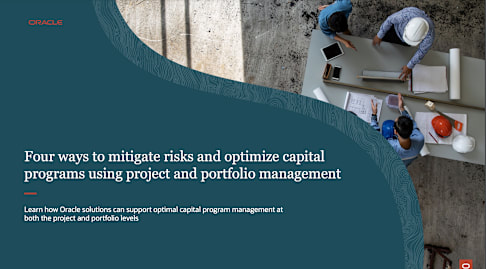
1Four ways to mitigate risks and optimize capital programs using project and portfolio management
Learn how Oracle solutions can support optimal capital program management at both the project and portfolio levels
Four ways to mitigate risks and optimize capital programs using project and portfolio management
2Four ways to mitigate risks and optimize capital programs using project and portfolio management
Managing increasingly complex capital programs and balancing portfolio-level needs of planning, budgeting, oversight, and reporting with project-level needs of collaboration, visibility, and data ownership is critical to success. Portfolio management requires cross-project corporate planning, funding, and oversight. Approved projects within a portfolio must be executed successfully to achieve targeted outcomes. Projects and programs must align to organizational goals. Data captured from the projects should be leveraged to improve operations and maintenance, and lessons learned should inform future projects and programs.
You can benefit from new insights including project-to-project learning from consistently captured data in standard formats across all projects in the portfolio. Consistency in project delivery data provides operations and maintenance with the same level of complete and accurate information to efficiently manage all the organization’s owned assets. No matter how many different contractors you work with, specifying a standard system and setup across all projects gives you the data consistency needed for it to be useful and valuable.
To prevent data loss, you must select a system that ensures you can truly own your project data with no risk of security breaches, loss, or alteration of the project record. Loss of data or trust in the data can have costly and long-lasting adverse impacts including potential inability to provide evidence for legislative, regulatory or insurance compliance, increased risk of disputes, and reduced efficiency in operations and maintenance.
Balancing project and portfolio level needs
2Four ways to mitigate risks and optimize capital programs using project and portfolio management
3Four ways to mitigate risks and optimize capital programs using project and portfolio management
Common risks across capital planning, delivery, and operations and maintenance
Projects and programs of capital works are inherently risky at every phase of the project lifecycle. Let’s take a look at common risks before outlining four ways to overcome those risks to optimize capital portfolios.
Planning
Lack of consistent portfolio planning processes and the data needed to support those processes can lead to wasted budget and suboptimal projects.
• Misalignment between approved projects and organizational goals results in wasted resources and potential loss of money.
• Inaccurate forecasting leads to higher than needed contingency allocation and cost, unnecessarily tying up funds that are better deployed in initiatives that contribute directly to the bottom line.
• A lack of confidence in project budgets due to inaccurate forecasting impedes future project approval and funding processes.
3Four ways to mitigate risks and optimize capital programs using project and portfolio management
4Four ways to mitigate risks and optimize capital programs using project and portfolio management
Delivery
Lack of consistent visibility across projects in the portfolio, limited or no access to a cross-organizational central system, and a lack of protected data ownership can make you lose confidence in project delivery and portfolio performance.
• Siloed information leads to suboptimal decision-making, which can negatively impact cost, scope, and schedule.
• When there’s no automated reporting at the project and portfolio levels, time is wasted compiling and formatting data instead of analyzing and acting on that data to take timely course correction to avoid adverse impact on cost, scope, and schedule.
• Non-centralized risk management processes across your portfolio lead to inconsistency, surprises, and funds being tied up to cover unknowns.
• Inadequate visibility into approval cycles, task status, and schedule impacts lead to delays in taking both corrective and proactive action, which are necessary to prevent avoidable scope changes and to keep the projects on track.
Operations and Maintenance
Although the operations and maintenance phase lasts decades longer than the construction phase, it often does not get as much focus as the planning or delivery phases. If the operations and maintenance phase is not taken into consideration during both planning and delivery, years of challenges and inefficiencies can follow.
• Data loss between project delivery and operations and maintenance can impact efficiency throughout the long asset life.
• Inadequate or unclear data ownership and management can lead to the owner’s inability to access data, optimally operate an asset, or demonstrate legislative, regulatory, or insurance compliance.
• Inconsistent data and data formats across projects within the portfolio handed over to operations and maintenance can result in service variability and challenges.
So how can you mitigate these risks and see better results for your capital programs using both project and portfolio management?
4Four ways to mitigate risks and optimize capital programs using project and portfolio management
5Four ways to mitigate risks and optimize capital programs using project and portfolio management
1. Improve cross-organization visibility and control by leveraging project-wide systems
• Use flexible, automated project-wide workflows to route and track all approval cycles.
• Implement a common data environment to ensure accuracy and accessibility of all project information.
• Collaborate on documents, drawings, and models using a secure system available to the entire project-wide team.
Managing, controlling, and mitigating risk is essential for owners to maximize control in capital programs. Risk management is not new, however, advances in technology offer unprecedented access to data, analytics, information, and insights that provide you with new capabilities in early warning and predictive functionalities.
Four ways owner organizations can mitigate risks, and improve project and portfolio results
2. Implement consistent portfolio-wide processes and systems to increase budget forecasting accuracy
• Proactively update forecasts based on actuals from projects across your portfolio.
• View real-time commits and actuals from current and past projects.
• Gain visibility across your portfolio to achieve real-time project-to-project learnings.
• Use preconfigured project- and portfolio-level reporting to reduce time spent compiling and delivering financial reporting.
Visibility of project status, cash-flow tracking, budget forecasts, and outlooks provide you with a clear picture of the committed capital at risk at any point in time throughout the portfolio. This visibility provides control, prevents surprise cost blow-outs, and allows you to assess the health of the committed capital. This enables you to adjust accordingly to either prevent a negative financial position or even increase output to deliver or exceed targets.
5Four ways to mitigate risks and optimize capital programs using project and portfolio management
6Four ways to mitigate risks and optimize capital programs using project and portfolio management
3. Reduce scope changes by increasing communication and collaboration
• Implement a project system that facilitates easy and timely RFI resolution.
• Bring all relevant stakeholders together for virtual model and drawing reviews without having to be in the same physical location or deal with hard copies or version control issues.
• Put a project-wide system in place at the very beginning of project planning to capture data and bring the team together from day one.
Information management within a centralized database—or common data environment—that can be trusted and relied upon enables efficient collaboration. Having data and information accuracy in addition to version control prevents errors and rework that increase costs and can then lead to significant delays or scope compromises, negatively impacting the overall success of the project.
4. Maximize use of project and portfolio data to inform decisions, prevent surprises, and improve future projects
• Implement a project-wide system that guarantees you own and control your project data.
• Connect data across project functions such as cost and schedule milestones to provide insights, increase control, and provide a full picture of project status.
• Centrally and consistently manage data to be able to compare and learn from project to project.
• Ensure complete and consistent project records across your portfolio to provide optimal information to support operations and maintenance.
• Connected data can provide the insights you need to optimize your planning, project execution, and decades of operations and maintenance.
Connected, consistent, and standardized data across your portfolio and projects enables data synchronization. This allows you to benefit from key insights and empower your teams to make informed decisions both across the portfolio and within individual projects.
6Four ways to mitigate risks and optimize capital programs using project and portfolio management
7Four ways to mitigate risks and optimize capital programs using project and portfolio management
• Improve alignment with corporate priorities: Portfolio planning solutions can assist in optimizing priority alignment. A consistent, data-driven approach with visibility into corporate priorities prevents unnecessary spending.
• Improve capital redeployment: Organizations frequently have excess capital confined in project contingency across their portfolio. Gain greater control and assurance over budgets and visibility into whether risk windows associated with contingency have passed. Reduce contingency and free up capital earlier in the process so that capital can be used on other productive projects.
• Smarter procurement and contractor cost savings: Visibility into your portfolio of corporate-wide projects facilitates procurement’s ability to forecast demand across projects, streamline vendor set up/administration, and bundle contractor discounts when sourcing labor or materials.
• Improve cost and contract management across your portfolio: Visibility across your portfolio of project costs and contractor progress facilitates the ability to assign or redirect resources and budget to make sure all projects within the program and portfolio remain on track.
• Increase assurance over successful project delivery by implementing a standard solution across your projects to ensure data consistency, accuracy, access and ownership. Bring your project teams together with equal access to a project-wide system, encouraging adoption and creating a full project record.
Realize the benefits today with improved project and portfolio management
7Four ways to mitigate risks and optimize capital programs using project and portfolio management
Futureproof your projects with Oracle Construction and Engineering
Ready to implement optimal capital portfolio management and construction project management for your projects? Get started today with Oracle’s Primavera Unifier Essentials and Oracle Aconex to maximize your capital budget and ensure operational readiness.
https://www.oracle.com/industries/construction-engineering/unifier-asset-lifecycle-management/essentials-datasheet/ https://www.oracle.com/industries/construction-engineering/unifier-asset-lifecycle-management/essentials-datasheet/ https://www.oracle.com/industries/construction-engineering/aconex-project-controls/
8Four ways to mitigate risks and optimize capital programs using project and portfolio management
Copyright © 2022 Oracle and/or its affiliates. This document is provided for information purposes only, and the contents hereof are subject to change without notice. This document is not warranted to be error-free, nor subject to any other warranties or conditions, whether expressed orally or implied in law, including implied warranties and conditions of merchantability or fitness for a particular purpose. We specifically disclaim any liability with respect to this document, and no contractual obligations are formed either directly or indirectly by this document. This document may not be reproduced or transmitted in any form or by any means, electronic or mechanical, for any purpose, without our prior written permission.
Oracle and Java are registered trademarks of Oracle and/or its affiliates. Other names may be trademarks of their respective owners.
CONNECT WITH US linkedin.com/showcase/oracle-construction-and-engineering/
facebook.com/OracleConstEng
twitter.com/OracleConstEng
blogs.oracle.com/construction-engineering/
https://twitter.com/OracleConstEng blogs.oracle.com/construction-engineering/
Button 2: Page 1: Page 2: Page 3: Page 4: Page 5: Page 6: Page 7: Page 8:
Button 4: Button 5: Button 6: Button 7: Button 8: Button 9: Button 10: Button 3: