Redefining Brick-And-Mortar for Post-COVID Realities
This Retail TouchPoints Special Report addresses how retailers can adapt store experiences to meet new customer expectations from contactless payments to personalization.
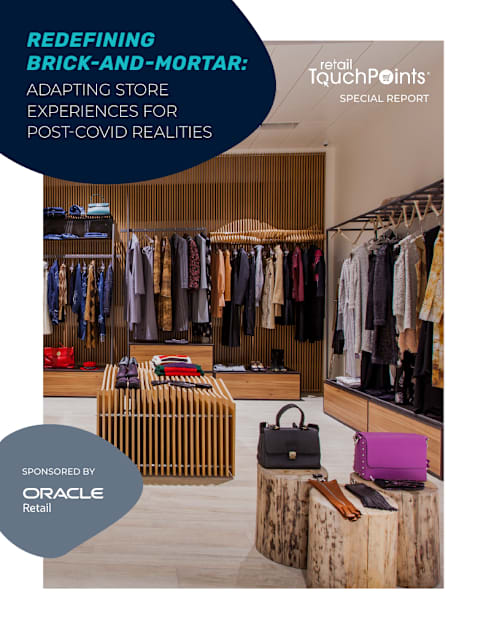
ADAPTING STORE EXPERIENCES FOR POST-COVID REALITIES
REDEFINING BRICK-AND-MORTAR:
SPONSORED BY
SPECIAL REPORT
https://www.oracle.com/index.html
2REDEFINING BRICK-AND-MORTAR: ADAPTING STORE EXPERIENCES FOR POST-COVID REALITIES
COVID-19 served as an accelerant for many long-standing retail trends, from ecommerce growth to contactless payments. But one area where the pandemic actually put on the brakes was experiential retail. Trips to those retailers that did remain open during the pandemic were focused on speed, necessity and safety. Now, however, as the pandemic wanes and shoppers begin to return to stores not just for function but for fun, a new era of omnichannel retail is set to emerge.
“COVID has created a massive opportunity,” said Denz Ibrahim, Head of Retail and Futuring at LGIM Real Assets in an interview with Retail TouchPoints. “It’s the first time that we’ve ever had an opportunity to press refresh with our customers. We’ve got customers coming back into our environments now that we haven’t seen for a year — it’s an opportunity to show them something new, to begin to engage in a new way.”
Retailers’ first task, however, is just getting shoppers back into physical stores — no easy feat with so many new converts to ecommerce.
“COVID was a real eye-opener for many retailers as to the importance of providing their customers, and their businesses for that matter, with some optionality,” said Shannon Warner, Partner in the consumer practice of Kearney in an interview with Retail TouchPoints. “I don’t think the debate any longer will be about prioritizing one channel over another, but rather about prioritizing a holistic customer experience that provides the option for the customer to shop how she wants, when she wants.”
Success in this “New Normal” will be characterized by merging the digital innovations that advanced so rapidly during the pandemic with the experiential, tactile elements that have always made in-store shopping a singular experience. Today’s leading retailers are doing this by:
• Recognizing a growing duality in consumer behavior between functional and experiential shopping, and catering to both kinds of customer journey, as Target has done;
• Integrating the mobile phone into every aspect of the shopping experience to create true omnichannel environments, as Walmart is attempting with its latest store redesign initiative; and
• Creating 360-degree environments that drive long-term brand affinity and reasons for consumers to return, even if those reasons aren’t directly tied to revenue, as Macy’s is looking to do at its Herald Square flagship.
INTRODUCTION
https://www.legalandgeneral.com/institutional/real-assets/ https://www.legalandgeneral.com/institutional/real-assets/ https://www.kearney.com/
3REDEFINING BRICK-AND-MORTAR: ADAPTING STORE EXPERIENCES FOR POST-COVID REALITIES
The role of the store is changing, driven by two very different consumer impulses. Alasdair Lennox, Group Executive Creative Director of Experience, Americas, at brand transformation company Landor & Fitch, described them as “time saving moments” and “spending time moments.”
“There is a big difference between functional and experiential shopping,” added Ibrahim. “Even four, five years ago there was a massive divergence in terms of what those two spheres looked like.”
Ironically, as consumers swing back toward the “spending time” side of the shopping pendulum, getting the experience right for those “time-saving” trips will become even more critical.
Ibrahim believes that many of these convenience-focused, functional shopping trips will migrate online, particularly now that so many consumers have discovered the ease and convenience of shopping from the comfort of their sofa. Yet research from brand experience firm Big Red Rooster, conducted in partnership with Engine Group, suggests that brick-and-mortar retail still offers compelling reasons for consumers to leave the comfort of their homes, even for more routine shopping. The companies’ recent Q1 2021 survey of 1,000 U.S. consumers found that:
Brick-and-mortar clearly still has a lot to offer on the functional side of the retail equation when it comes to control, connection and — while it might seem a bit counterintuitive given the presumed advantages of ecommerce — convenience. Sometimes even two days (or two hours) is too long to wait.
Kearney’s Warner pointed to Target as an example of effectively threading the needle between function and experience: “About four years ago Target said, ‘We will be a store-first omnichannel retailer,’ and they redesigned their stores so that they became nodes in their supply chain,” she said. “Their sales floors are there to support all types of customers, no matter how they’re shopping. I think we’ll continue to see that evolution of the purpose of the store with other retailers as well.”
Target’s enhanced fulfillment strategies didn’t happen in a vacuum. They went hand in hand with a revamped loyalty program, robust app build-out and consistent collaborations and product launches — all of which have served to make Target a go-to for day-to-day needs, but with enough variety that even regular customers have reasons to return.
EVEN AS SHOPPERS MIGRATE ONLINE, STORES STILL PLAY IMPORTANT DAY-TO-DAY ROLES
of those surveyed go to brick-and-mortar because they know exactly what to expect from the experience;
shop in-store because they want the product immediately;
visit physical locations because they want to pick out products themselves;
will travel to a store to connect with, ask questions or get help from store associates in person.
76% 74%
72% 55%
https://landorandfitch.com/ https://www.bigredrooster.com/ https://enginegroup.com/us/ https://www.target.com/ https://retailtouchpoints.com/features/news-briefs/target-circle-loyalty-program-goes-national
4REDEFINING BRICK-AND-MORTAR: ADAPTING STORE EXPERIENCES FOR POST-COVID REALITIES
One functional aspect of the shopping experience that doesn’t look like it’s going away any time soon is concerns about health and safety. In March 2021, only 39% of respondents in Big Red Rooster’s Q1 survey said that they felt safe on their last visit to a store. This actually represents a decrease from the firm’s Q4 pulse survey in December 2020, when 49% said they felt safe.
“Consumers are feeling anxious in stores,” said Emily Albright Miller, SVP, Strategy & Insights at Big Red Rooster in an interview with Retail TouchPoints. “We’re all sort of scarred, and that’s something that is important for retailers to understand; they need to find ways to make [consumers] feel in control. If shoppers are anxious, they’re not spending enough time in your store, they’re not spending enough money and they’re not going to visit as frequently, so it has some pretty serious implications.”
While technologies like touchless transactions took off during the pandemic, Albright Miller said they were actually low on the list of things that make consumers feel more safe in stores, according to the company’s research. “Anything that was highly visible is what was making people feel the most safe,” she said. “Seeing an employee wipe down counters or handles, for example, or masks and social distancing — things that are really in their face.”
“Consumers are in wildly different places about their level of comfort for their health and safety,” added Warner. “Retailers need to be very sensitive to that. It actually makes things more complicated, because as retailers, we’ve spent a long time figuring out how to personalize the services that we offer. Now, those core customer segments have yet one more dimension that we have to think about in how we’re servicing them.”
CONSUMERS SEEK REASSURANCE AS SAFETY AND HYGIENE CONCERNS LINGER
“If shoppers are anxious, they’re not spending enough time in your store, they’re not spending enough money and they’re not going to visit as frequently, so it has some pretty serious implications.”
– Shannon Warner, Kearney
5REDEFINING BRICK-AND-MORTAR: ADAPTING STORE EXPERIENCES FOR POST-COVID REALITIES
Even if touchless transactions don’t prove pivotal in the effort to reassure COVID-cautious consumers, mobile technologies like touchless have become pivotal to the overall store experience. “COVID really helped to accelerate mobile retail experiences, especially using mobile in stores to facilitate search transactions and for things like contactless payments,” said Warner. “I don’t think that’s going back. Consumers love their mobile devices and are very comfortable using them. Now that they’ve discovered new ways to use them, they’ll continue to do that, and word of mouth will drive more and more customers to do the same.” Data backs up Warner’s assertion. In 2020, eMarketer estimated that 92.3 million U.S. shoppers used their mobile phones for proximity payments, and that number is expected to increase to 125 million by 2025. In fact, if you ask Lennox, mobile will be at the center of all aspects of retail going forward. “I’m absolutely over the phrase omnichannel,” he said in an interview with Retail TouchPoints. “After living through multichannel and omnichannel I feel like we’re on the other side. Mobile-first retail is where I’ve been seeing it going. Using your smartphone to activate stores is one of the biggest things that we have seen.” To illustrate his point, Lennox pointed to Walmart’s new store design, which his company helped develop. He calls it “swipe up retail.” Unveiled in September 2020 and set to roll out across 800 stores by the end of 2021, the new store experience is centered on digital. Product categories have been rearranged and in-store signage redesigned to align with the Walmart app, and customers entering the store are greeted with a directory that encourages them to use the app while they shop. “Walmart was arguably omnichannel [before the redesign], but when you went into the store it was still an old school mindset of ‘Now be a good shopper and put the phone in your pocket and focus on us,’” explained Lennox. “It was an analog experience. The concept of ‘swipe up retail’ is [that] your smartphone has all the more functionality when you’re actually in the Walmart. It can take you on a journey. You can check out, you can get more product information, you get coupons and deals. It’s all around having the phone in your hand and pushing the trolley [aka cart for American readers].” Creating this connection between physical and digital answers a crucial consumer need — one that’s driven by the contrast with the somewhat detached world of ecommerce. “In this increasingly digital world, consumers crave that personal connection, they crave a sense of belonging and retailers that show their customers they understand them,” said Warner. “Retailers that are able to connect those dots to create unique and personalized experiences will be much better positioned to create long-lasting relationships.”
MOVE OVER OMNICHANNEL — MOBILE-FIRST RETAIL HAS ARRIVED
“Mobile-first retail is where I’ve been seeing it going. Using your smartphone to activate stores is one of the biggest things that we have seen.”
– Alasdair Lennox, Landor & Fitch
https://www.emarketer.com/content/whats-driving-proximity-mobile-payment-usage-growth?ecid=NL1001 https://www.walmart.com/ https://corporate.walmart.com/newsroom/2020/09/30/reimagining-store-design-to-help-customers-better-navigate-the-omni-shopping-experience
Retail TouchPoints: How do you see the idea of omnichannel retail being reimagined in the post- COVID world? Chris Sarne: Customer remains the center of the universe for retail. Many of the changes are due to an acceleration of existing trends, not from a wholesale reimagining of retail. We see customer journeys emerge and extend from curbside pickup, delivery, mobility, self-serve and the increased digitization of the store to meet customer expectations. In that case, many of our customers were investigating or piloting these journeys before the pandemic. However, we did see a significant increase in the agility of our customers and a lot more bootstrapping of solutions. For example, an initiative like curbside pickup, which might have taken a [retailer] customer several months to imagine, gather requirements for, integrate, test and implement, is now delivered in a matter of weeks and then refined over time. RTP: What omnichannel offerings in particular do you think will become “must-haves” for most retailers in the New Normal, and why?
Sarne: Customer expectations have continued to accelerate even at the height of COVID. We strongly believe that all of the new customer journeys rolled out during COVID are likely here to stay. We have heard things like “I’m never putting another bag of dog food in my trunk ever again,” and every retailer we discuss this with agrees. Curbside pickup, delivery, vastly improved in-store inventory accuracy and contactless payments are now considered table stakes. As a retailer, not knowing your in-store inventory is inexcusable now.
The perspective of the consumer is that their interaction is with a brand and not a channel. As we continue to see the blurring of the lines between digital and physical retail, it is the overall experience that will be considered must-haves. Consumers have come to expect personalization in digital channels, but personalization in a brick-and-mortar context will be more and more common as the blurring continues. If we look at ecommerce specifically, retailers discovered that consumers were looking at the overall interactions as well. Ecommerce traffic increased across the board, but at a minimum now, most retailers will have BOPIS or curbside pickup to meet the customer’s expectations.
POST-COVID STORE EXPERIENCE STRATEGIES: Q&A WITH CHRIS SARNE, SENIOR DIRECTOR PRODUCT MANAGEMENT STRATEGY AT ORACLE RETAIL
6REDEFINING BRICK-AND-MORTAR: ADAPTING STORE EXPERIENCES FOR POST-COVID REALITIES
https://blogs.oracle.com/retail/post/from-cash-to-contactless-accelerating-payment-technology-to-meet-consumer-demand https://www.oracle.com/index.html
7
RTP: How have the events of the last year and a half changed the store’s role in the shopper journey?
Sarne: [The changes have been] different by vertical and geography. Many changes were because many geographies saw stores closed for significant periods. Some of the developments that we saw were more impactful. For instance, dark stores — where retailers leverage storefronts to fulfill orders — were relatively rare before 2020, and those will stick around. We predict that we will see a significant increase in micro- fulfillment from stores and increased home deliveries because it’s efficient and local.
Online shopping has undoubtedly seen significant increases, which will probably level off at around 20% of retail sales in the next year or two. Even with the big revenue jump in ecommerce, many consumers are missing the social aspects of shopping. Research consistently points out that consumers, particularly Gen Z and millennials, are looking forward to having the option of going back to a store for a social experience. We are also seeing a trend where pure-plays are opening stores, not because they expect to have retail coverage, but because they understand that stores are among the best ways to improve customer acquisition. RTP: What crucial skills and systems must retailers have in place to deliver on consumers’ new expectations for the in-store experience?
Sarne: The most important thing retailers need to be successful in omnichannel retail is delivering the transparency of items, inventory, order, price and customer. Order management systems that support omnichannel order orchestrations have seen a significant increase in relevancy. Shared services for inventory, or pricing and promotion, are becoming more critical. The store associate is vital in any omnichannel transformation. Still, associates need to be equipped with the right tools to succeed, whether visibility into product and availability or mobility, to engage a customer on the store floor properly.
New experiences like having shoppers and associates at home and doing remote selling are also excellent examples of how the “four walls” of the store are breaking down, and how modern retailers can take advantage of emerging experiences. It’s also vital that associates are given the training and the tools to ensure that every new initiative and journey is entirely on-brand for the retailer.
One of the most important things COVID has taught us is that retailers need to be significantly more agile to succeed in this hyper-competitive environment. That includes being allowed to fail fast and deliver a minimum viable product quickly while refining and improving it over time. RTP: What’s next for omnichannel retail? What up-and-coming innovations do you find particularly exciting?
Sarne: AI and machine learning are going to be the next must-haves that will become mainstream. Data, particularly customer data, will become the lifeblood of the retail enterprise. Being able to gather data from throughout the retail enterprise, enhance it and use AI and machine learning to find deeper insights will empower strategic decisions while preparing businesses for the future. Using that data to inform decisions, create personalization, build experiences through segmentation or campaigns or understand the customer’s “next expected purchase” will also become more mainstream.
REDEFINING BRICK-AND-MORTAR: ADAPTING STORE EXPERIENCES FOR POST-COVID REALITIES
https://blogs.oracle.com/retail/post/awaken-dark-stores-by-rethinking-how-to-use-them https://blogs.oracle.com/retail/post/achieve-profitable-customer-acquisition-and-retention https://www.oracle.com/industries/retail/omnichannel/ https://www.oracle.com/industries/retail/products/order-management-system/ https://www.oracle.com/industries/retail/ai-analytics/ https://www.oracle.com/index.html
8REDEFINING BRICK-AND-MORTAR: ADAPTING STORE EXPERIENCES FOR POST-COVID REALITIES
For much of last year, in-store behavior was relegated to the “time saving” column, but with lockdowns and masks beginning to drop, consumers are increasingly looking to retail as a place for spending time. However, retail experiences that may have sufficed back in 2019 will no longer make the grade — after the events of the past year, consumers are looking for excitement and novelty when they take the time to go to a store for more than just basic needs. Take for example the new M&M’s store that recently opened in the Mall of America. It’s so far away from functional retail that Lennox describes it as “roller coaster retail.” (That’s a high bar when you consider that the mall in which it resides has several actual roller coasters.) The 24,000-square-foot store is designed as a brand experience, complete with opportunities for customers to “express their personality through color, sound and movement,” a rooftop celebration of the local Minnesota landscape, ample photo opportunities and more — all for free. “We all know that mall, and in the midst of the food halls and literal roller coasters M&M’s isn’t like, ‘We’re the shop where you act like a shopper. You buy things and we put it in a box,’” said Lennox. “It’s that blend — it’s part shop, part entertainment park, and that is where people want to spend time.” While transforming a store into an entertainment park represents the extreme end of the experiential spectrum, virtually all retailers will need to find brand-appropriate ways to feed shoppers’ hunger for newness and entertainment. “People will come back to retail, because we’re just desperate to do interesting things, but when we start to come back the second time to stores, or the third, and they look the same, I worry there’ll be a very quick drop-off,” said Lennox. “I think the most important thing for retail brands to do is put their money more into the OPEX than the CAPEX of making sure that their store experience is constantly changing. “When we go online it changes constantly, and that’s why it is arguably so addictive and compelling,” Lennox added. “Here I am on my sofa, I can shop for any product or service in the world. Why would I make the effort of schlepping into town or going down the road? It must be the desire for new. Spend less on the new builds and put all your energies and monies into making the stores morph and shape-change, and bringing in new products and partnerships and collabs to make it exciting.”
THE NEW ERA OF EXPERIENTIAL RETAIL: 360-DEGREE ENVIRONMENTS THAT INCLUDE NON-RETAIL ELEMENTS
https://retailtouchpoints.com/topics/retail-store-design/experiential-retail/mms-opens-new-experiential-store-at-mall-of-america
9REDEFINING BRICK-AND-MORTAR: ADAPTING STORE EXPERIENCES FOR POST-COVID REALITIES
According to Ibrahim, the biggest reason retail environments die is because they become stale. “When you begin to think about the ‘live-life’ and ‘work-life,’ they’re becoming much more fluid, and that has a direct impact on how we use what I call the ‘play-life’ — the bit in-between. If you create the right platform, the shopping center can become the place where people want to meet and network and talk and socialize — and that just happens to sit in front of great shopping. It becomes a melting pot for something that you can’t really put your finger on, but it’s completely commercially viable because there’s high dwell time, there’s high engagement and there’s a reason to keep coming.” Ibrahim is testing his theory with an expansive redevelopment of the Kingland Cresent shopping district in Poole, England, which aims to completely reimagine the shopping center experience. Central to the new vision for the district is creating a strong presence of local small- and medium enterprises (SMEs, the UK version of SMBs), which LGIM Real Assets is facilitating by giving 10 local businesses free rent for two years. The center will also include co-working spaces and an adult education college, and host more than 1,000 events this year, everything from yoga sessions to chess club meet-ups. “Historically our shopping centers were 100% retail,” he said. “We see that shrinking massively to 50%-60% retail, but really really good retail, and the other proportion of that space is going to be filled through SME brands that are really engaged with their community, markets, events, workplace, healthcare, education. That will begin to piece together a completely 360-degree environment, which is in the heart of those communities and towns.”
TIME SPENT WITH A BRAND CAN GENERATE JUST AS BIG A PAYOFF AS ACTUAL DOLLARS SPENT
Local independent shops at the newly redesigned Kingland Crescent shopping center in Poole, England
https://www.nytimes.com/2021/06/04/business/can-the-pandemic-rescue-britains-shopping-areas-this-town-hopes-so.html
10REDEFINING BRICK-AND-MORTAR: ADAPTING STORE EXPERIENCES FOR POST-COVID REALITIES
Macy’s is taking a similar tack with its $235 million investment in its flagship Herald Square location in New York City. Almost all of that money is being spent not on the store itself but on the communal spaces surrounding the store, including improvements to the neighborhood’s transit infrastructure and the development of a “modern, pedestrian-friendly urban space,” according to the company. For many retailers, shifting the focus from short-term returns to longer-term investments in the overall consumer experience might seem like a leap that is hard to justify to financial stakeholders, but Lennox said that attitude is short-sighted. “The challenge a lot of retailers have is, what are the KPIs of success?” said Lennox. “I think how progressive they are in their KPIs is a barometer of how successful they will be. Sales per square foot and till turnovers and footfall have been the retail KPIs forever and a day. People spending time with your brand, people creating social content, the memories taken away — those are the new KPIs, equally as important as the sales. To retailers who say, ‘I can’t see the immediate revenue of that’ I say, ‘You’re not seeing the bigger picture of how we as people are spending our time and money today.’”
Artist rendering of the exterior of Macy’s Herald Square location once improvements are complete. ©FXCollaborative
https://www.macys.com/ https://retailtouchpoints.com/topics/retail-store-design/macys-doubles-down-on-nyc-flagship-location-with-235m-investment-in-herald-square-revitalization
11REDEFINING BRICK-AND-MORTAR: ADAPTING STORE EXPERIENCES FOR POST-COVID REALITIES
LEARN MORE...
201.257.8528 info@retailtouchpoints.com
Retail TouchPoints and design:retail give all members of the retail world access to a vibrant community that combines insights, inspiration and opportunities to interact with their peers. We sit at the intersection of the art and science of retail strategy, providing granular data, high-value commentary, and aspirational success stories to help readers optimize customer experiences across all channels. Touching all facets of the retail ecosystem, including store experience and design, workforce management, digital marketing and engagement, and omnichannel optimization, our editorial content, multi-media resources and events take timely news and trends and transform them into tactical takeaways that meet the unique needs and priorities of our executive readers.
Oracle is the modern platform for retail. Oracle provides retailers with a complete, open, and integrated platform for best-of-breed business applications, cloud services, and hardware that are engineered to work together. Leading fashion, grocery, and specialty retailers use Oracle solutions to accelerate from best practice to next practice, drive operational agility, and refine the customer experience. For more information, visit our website, www.oracle.com/retail.
1.650.506.7000 oneretailvoice_ww@oracle.com
ABOUT THE AUTHOR
Nicole Silberstein, Ecommerce Editor Nicole covers the retail industry at large with a focus on ecommerce, looking at digital
innovation and the evolution of modern retail.
https://retailtouchpoints.com/ mailto:info%40retailtouchpoints.com?subject= https://www.linkedin.com/company/retail-touchpoints/ https://twitter.com/RTouchPoints https://www.facebook.com/RetailTouchPoints/ https://retailtouchpoints.com/blog https://www.instagram.com/rtouchpoints/ http://www.oracle.com/retail https://www.linkedin.com/company/oracle-retail/ https://twitter.com/OracleRetail https://www.facebook.com/oracleretail mailto:oneretailvoice_ww%40oracle.com?subject= https://www.oracle.com/index.html