IDC MarketScape: Worldwide Retail Merchandise Operations Management Solutions 2020–2021 Vendor Assessment
IDC Positioned Oracle as a Leader in Retail Merchandising Solutions. The report assesses the capabilities and strategies of leading enterprise software vendors in serving the specific needs of retail companies worldwide by evaluating their success in executing basic merchandising activities such as item management, inventory tracking, purchasing, and vendor management for a complete retail merchandising operations management solution.
December 2020, IDC #US47029020e
IDC MarketScape
IDC MarketScape: Worldwide Retail Merchandise Operations Management Solutions 2020–2021 Vendor Assessment
Jon Duke
THIS IDC MARKETSCAPE EXCERPT FEATURES: ORACLE
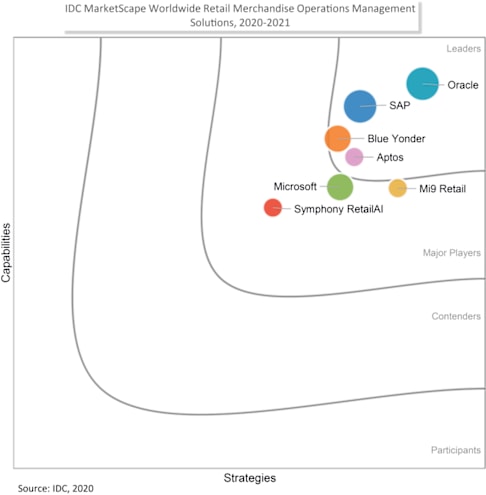
IDC MARKETSCAPE FIGURE
FIGURE 1
IDC MarketScape Worldwide Retail Merchandise Operations Management Solutions
Vendor Assessment
Source: IDC, 2020
©2020 IDC #US47029020e 2
Please see the Appendix for detailed methodology, market definition, and scoring criteria.
IN THIS EXCERPT
The content for this excerpt was taken directly from IDC MarketScape: Worldwide Retail Merchandise
Operations Management Solutions 2020–2021 Vendor Assessment (Doc #US47029020). All or parts
of the following sections are included in this excerpt: IDC Opinion, IDC MarketScape Vendor Inclusion
Criteria, Essential Guidance, Vendor Summary Profile, Appendix and Learn More. Also included is
Figure 1.
IDC OPINION
Keeping up with the exponentially increasing speed and complexity of modern retail requires not just
customer-facing initiatives but also a robust and flexible merchandise operations solution that provides
a critical foundation for the future of retail. Capabilities that are highly visible to the customer, yet built
on legacy systems that were never designed to support modern processes, are inefficient, often
ineffective, and ultimately incapable of enabling optimal customer experiences that are demanded of
retailers today. Sometimes, the decision to invest in a new merchandising system is event driven — a
situation where retailers can't keep the lights on unless they upgrade, like an acquisition that
significantly increases scale, international expansion, or entering an adjacent line of business. In other
situations, the challenge is cumulative in effect, where there is a growing list of annoyances that
individually don't have a significant business impact but collectively create inefficiencies that inhibit
growth.
Retail of the future is customer driven and analytically robust. Modern merchandise operations
management solutions are purpose built for the analytical and experiential requirements of today and
have the flexibility to expand on and enhance those capabilities in the future.
In our research and through discussions with a wide range of retailers about what aspects of modern
merchandise operations management solutions are critical, several things stand out:
▪ The best merchandise operations management solution focuses on helping retailers serve
their customers better, enabling better experiences, faster.
▪ Retailers want a foundational merchandising system that is purpose built for the analytical and
experiential requirements of modern retail.
▪ Leading technology vendors are focused on helping retailers future-proof their organizations,
anticipating and planning capabilities that meet their future needs while providing the flexibility
to expand on and enhance those capabilities in the future.
▪ Modern merchandise operations management solutions have a high degree of automation
built into as many processes as possible, helping retailers drive efficiency and accuracy while
reducing the administrative workload of their employees.
As we assessed the range of vendors in this IDC MarketScape, these four areas were of critical
importance to retailers, but many were less satisfied with their current solutions' ability to meet these
needs. As such, throughout the research, these areas proved to be strong points of differentiation
among vendors.
©2020 IDC #US47029020e 3
IDC MARKETSCAPE VENDOR INCLUSION CRITERIA
Merchandise operations management software is the system of record for merchandising in retail.
These solutions typically represent the core product management system in most retailers, executing
basic merchandising activities such as item management, inventory tracking, purchasing, and vendor
management. Although they are responsible for managing and executing core retail functions and
operational tasks, they generally do not perform analyses or offer insights to support merchandising-
related decision making (e.g., planning, forecasting, and optimization). Merchandise management is
usually tightly integrated with other applications that perform such functions, either as part of a
vendor's own software portfolio or with solutions from other vendors (e.g., price/promotion
optimization, inventory planning, and merchandise financial planning).
Participants in this vendor assessment:
▪ Are established software vendors with prominent/visible market presence
▪ Deliver an enterprise-grade merchandise operations management solution for retail
▪ Have a solution that is capable of supporting tier 1 retailers at global scale, across both
ecommerce and brick-and-mortar stores
▪ Own the intellectual property of the merchandise operations management solution (developed
in-house or acquired via transaction)
ADVICE FOR TECHNOLOGY BUYERS
For organizations farther along the digital transformation journey, investing in a new merchandise
operations management solution is an opportunity to go back to the basics, fixing and streamlining
what likely have been band-aid solutions, workarounds, and inefficient processes that, while enabling
critical processes and downstream analytics, decision support systems, and customer-facing
capabilities, also have collectively created challenges and limitations for the organization.
For organizations that are earlier in their transformation journey, merchandise operations management
solutions are a foundational element in the road map that can seamlessly enable future capabilities
and solutions along the journey. Investing now, at the start of your journey, means getting it right the
first time and avoiding needless workarounds and patches down the road, which will ultimately mean
an improved ability to quickly and efficiently adjust to the rapidly changing needs of the business.
In either case, there are several important considerations as you scan the market for the best solution
for your organization:
▪ Look for solutions that are oriented toward the future of retail — those that are focused on
helping you serve the end consumer better, that are purpose built for improved analytical
capabilities, and that are focused on driving deeper automation across your organization.
▪ Look for vendors that can deliver what your organization needs in an out-of-the-box solution
versus one that is customized. Leveraging an out-of-the-box solution can speed
implementation, lower the overall investment, improve ongoing maintenance costs, and ease
change management.
▪ Consider investing simultaneously in related solutions (e.g., customer data system, analytics,
and insights engine) that not only create additional benefits but also make investment more
efficient and change management easier.
©2020 IDC #US47029020e 4
▪ Consider vendors that can help you assess current processes and have a clear understanding
of exactly how those will need to change in the future. Engaging the vendor on this early, prior
to investment, will give your organization a transparent understanding of the impact.
VENDOR SUMMARY PROFILES
This section briefly explains IDC's key observations resulting in a vendor's position in the IDC
MarketScape. While every vendor is evaluated against each of the criteria outlined in the Appendix,
the description here provides a summary of each vendor's strengths and challenges.
Oracle
After a thorough evaluation of Oracle's strategies and capabilities, the company is positioned in the
Leaders category in our 2020 IDC MarketScape for worldwide merchandise operations management
solutions.
Oracle, founded in 1977, is a publicly held corporation headquartered in Redwood Shores, California.
It is one of the largest infrastructure, applications, and services companies serving the retail industry
worldwide. Oracle entered the merchandise operations management market in 2005 when it
purchased the Minneapolis-based Retek, which at the time had approximately 500 retail-focused
employees. Today, Oracle's retail suite offers a complete range of solutions across retail planning,
optimization, and execution applications, including price, promotion, and markdown optimization;
financial planning; assortment optimization; supply chain management; and omni-channel solutions.
Quick facts:
▪ Employees: 135,000 employees worldwide
▪ Global footprint: Broad range of customers globally; balanced representation across regions
▪ Years offering MOM solution: 15 years under Oracle ownership; 26 years total (inclusive of
Retek)
▪ Retail segment focus: Customers balanced across segments and skew slightly toward the
grocery and convenience and footwear and apparel segments
▪ Customer size focus: Has customers across a range of sizes, from the largest tier 1
enterprises to midmarket growth retailers
▪ Most important road map/functionality updates: Expanding upon embedded AI/ML capabilities
to drive toward autonomous merchandising, simplification and efficiency for manual
processes, expanding wholesale capabilities
▪ Key partners: Oracle Retail Consulting, Accenture, Deloitte, Logic, and Retail Consult
▪ Interesting customer facts: Oracle counts many of the largest and most recognizable retailers
among its customers, including many of the largest and well-known brands regardless of
segment including grocers, apparel companies, discount retailers, department stores,
pharmacies, and major consumer electronics retailers
Strengths
▪ Ability to support scale and complexity: Oracle has had demonstrable success in supporting
large, complex retail organizations across the globe and across retail segments. The
company's ability to deliver in a variety of deployment models, including SaaS, makes it a top-
of-mind option for retailers.
©2020 IDC #US47029020e 5
▪ End-consumer focus: The company speaks often about its own internal pivot to the consumer.
This is reflected in the company's strategic orientation moving forward, helping retailers better
serve the end consumer, and is demonstrated by the degree of resources the company
devotes to better understanding consumers and their journeys.
▪ Automation: Oracle appears keenly aware of the importance of automation to retailers. As it
drives toward autonomous merchandising, the company's customers that we spoke with are
highly satisfied with the degree of automation built into its merchandising solution.
Challenges
▪ Cost to value: A downside of operating at the size and scale of Oracle and the customers that
it supports is that it tends to be perceived as a higher-priced option. While customers report a
strong perception of value, their cost perception can be a hurdle in some cases.
▪ Orientation toward the future of retail: Oracle has a clear understanding of the future of retail
and is pointing its strategy toward helping retailers solve these challenges. Its customers don't
always fully perceive this, but many do, and it's clear that the Oracle team is moving quickly in
the right direction. Continuing to drive messaging around the company's vision of the future
will help.
Consider Oracle When
Oracle has a good pulse on the market and the needs of retailers. Companies with room to invest in
the future of their organizations should have Oracle in their consideration set, particularly if they have
the scale and complexity in their operations that require a partner with the proven ability to support
this.
APPENDIX
Reading an IDC MarketScape Graph
For the purposes of this analysis, IDC divided potential key measures for success into two primary
categories: capabilities and strategies.
Positioning on the y-axis reflects the vendor's current capabilities and menu of services and how well
aligned the vendor is to customer needs. The capabilities category focuses on the capabilities of the
company and product today, here and now. Under this category, IDC analysts will look at how well a
vendor is building/delivering capabilities that enable it to execute its chosen strategy in the market.
Positioning on the x-axis, or strategies axis, indicates how well the vendor's future strategy aligns with
what customers will require in three to five years. The strategies category focuses on high-level
decisions and underlying assumptions about offerings, customer segments, and business and go-to-
market plans for the next three to five years.
The size of the individual vendor markers in the IDC MarketScape represents the market share of each
individual vendor within the specific market segment being assessed.
IDC MarketScape Methodology
IDC MarketScape criteria selection, weightings, and vendor scores represent well-researched IDC
judgment about the market and specific vendors. IDC analysts tailor the range of standard
characteristics by which vendors are measured through structured discussions, surveys, and
interviews with market leaders, participants, and end users. Market weightings are based on user
©2020 IDC #US47029020e 6
interviews, buyer surveys, and the input of IDC experts in each market. IDC analysts base individual
vendor scores, and ultimately vendor positions on the IDC MarketScape, on detailed surveys and
interviews with the vendors, publicly available information, and end-user experiences in an effort to
provide an accurate and consistent assessment of each vendor's characteristics, behavior, and
capability.
Market Definition
Merchandise operations management software is the system of record for merchandising in retail.
These solutions typically represent the core transactional system in most retailers, executing basic
merchandising activities such as item management, inventory tracking, purchasing, and vendor
management. Data is input directly or fed from a product information management (PIM) solution, and
it forms the foundation for planning and optimization solutions, supply chain planning and execution,
store operations, and commerce.
Merchandise operations management systems hold merchandising data from which core retail metrics
are derived (sales, units, cost, and their derivatives). Although they are responsible for managing and
executing core retail functions and operational tasks, they generally do not perform analyses or offer
insights to support merchandising-related decision making (e.g., planning, forecasting, and
optimization). Merchandise management is usually tightly integrated with other applications that
perform such functions, either as part of vendor's own software portfolio or with solutions from other
vendors (e.g., price/promotion optimization, inventory planning, and merchandise financial planning).
LEARN MORE
Related Research
▪ IDC Perspective: Importance and Satisfaction Gaps in Retail Merchandise Operations
Management Solutions (IDC #US47093720, forthcoming)
▪ IDC PlanScape: Customer-Driven, Intelligence-Backed Space and Assortment Planning (IDC
#US46627520, June 2020)
▪ IDC Web Conference Proceeding: Future of Retail (IDC #US46112520, March 2020)
▪ IDC PlanScape: Retail Merchandise Operations Management Solutions (IDC #US45441419,
September 2019)
Synopsis
This IDC study provides an assessment of the principal retail merchandise operations management
solutions and discusses what criteria are most important for companies to consider when selecting a
vendor.
"Modern merchandise operations management solutions are purpose built for the analytical and
experiential requirements of today and have the flexibility to expand on and enhance those capabilities
in the future," says Jon Duke, vice president of research for IDC Retail Insights. "And there is clear
differentiation among vendors' ability to meet the challenging demands of retailers."
About IDC
International Data Corporation (IDC) is the premier global provider of market intelligence, advisory
services, and events for the information technology, telecommunications and consumer technology
markets. IDC helps IT professionals, business executives, and the investment community make fact-
based decisions on technology purchases and business strategy. More than 1,100 IDC analysts
provide global, regional, and local expertise on technology and industry opportunities and trends in
over 110 countries worldwide. For 50 years, IDC has provided strategic insights to help our clients
achieve their key business objectives. IDC is a subsidiary of IDG, the world's leading technology
media, research, and events company.
Global Headquarters
5 Speen Street
Framingham, MA 01701
USA
508.872.8200
Twitter: @IDC
idc-community.com
www.idc.com
Copyright and Trademark Notice
This IDC research document was published as part of an IDC continuous intelligence service, providing written
research, analyst interactions, telebriefings, and conferences. Visit www.idc.com to learn more about IDC
subscription and consulting services. To view a list of IDC offices worldwide, visit www.idc.com/offices. Please
contact the IDC Hotline at 800.343.4952, ext. 7988 (or +1.508.988.7988) or sales@idc.com for information on
applying the price of this document toward the purchase of an IDC service or for information on additional copies
or web rights. IDC and IDC MarketScape are trademarks of International Data Group, Inc.
Copyright 2020 IDC. Reproduction is forbidden unless authorized. All rights reserved.