Oracle Named Leader in IDC MarketScape: Worldwide Point-of-Sale Software for Large Apparel and Softlines Retail 2023 Vendor Assessment
This IDC MarketScape report assesses the capabilities and strategies of enterprise POS software solution providers that have a significant presence in the large apparel/softlines retail segment. Find out why Oracle is named a leader.
March 2023, IDC #US48621522e
IDC MarketScape
IDC MarketScape: Worldwide Point-of-Sale Software for Large Apparel and Softlines Retail 2023 Vendor Assessment
Margot Juros
THIS IDC MARKETSCAPE EXCERPT FEATURES ORACLE
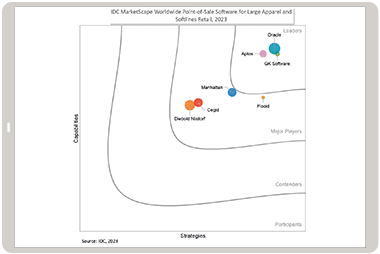
IDC MARKETSCAPE FIGURE
FIGURE 1
IDC MarketScape Worldwide Point-of-Sale Software for Large Apparel and Softlines
Retail Vendor Assessment
Source: IDC, 2022
Please see the Appendix for detailed methodology, market definition, and scoring criteria.
©2023 IDC #US48621522e 2
IN THIS EXCERPT
The content for this excerpt was taken directly from IDC MarketScape: Worldwide Point-of-Sale
Software for Large Apparel and Softlines Retail Vendor Assessment (Doc # US48621522). All or parts
of the following sections are included in this excerpt: IDC Opinion, IDC MarketScape Vendor Inclusion
Criteria, Essential Guidance, Vendor Summary Profile, Appendix and Learn More. Also included is
Figure 1.
IDC OPINION
The past few years have introduced a world of change in shopper expectations. Consumers now
expect seamless, frictionless omni-channel commerce with the ability to shop from anywhere and pick
up or ship products in any way they wish, as well as new demands for contactless and alternative
methods of payment. Apparel retailers need a point-of-sale (POS) software solution that enables them
to support new expectations while, at the same time, aid in achieving critical business goals of driving
revenue and enhancing personalization for better customer engagement and experience, which can
distinguish their brand and drive customer loyalty.
To achieve these objectives, apparel retailers need to leverage technology that can address some of
the complexities of today's apparel segment. POS software providers that emerged as leaders in this
space are addressing some of the unique needs in apparel including endless aisles, mixed-channel
carts, clienteling, and mobile POS, as well as self-checkout, which is of new interest in apparel. In
addition, frictionless payments have become a real differentiator for customers, with shoppers citing
contactless payments as the number 1 feature to improve their in-store shopping experience (see
Consumer Sentiment Survey, 2022: Findings and Implications, IDC #US49621522, August 2022). At the same time, with the spotlight on enhancing customer personalization and engagement, retailers
need omni-channel solutions that prioritize integrating data from across retail operations and
customers. Ideally, these solutions will enable a single point of truth with trusted, up-to-date data
stored in a specific location that is easily available for drawing keen insights and recommendations.
Amid this period of rapidly changing expectations and business conditions, retailers of all sizes have
realized the importance of digital capabilities and strategies to be more agile and able to pivot on a
dime as things change. As such, POS solutions can be both enabler and partner to apparel retailers in
achieving rapid innovation and agility. With regard to large retailers in particular, there is a more
pressing need for POS offerings enabled for multiple countries (the more the better) that take into
account localized preferences as well as compliance and regulations. In addition, apparel retailers are
increasingly seeking offline resiliency capabilities from POS providers so transactions can continue
even when the store is down.
With the pace of change in the current environment, retailers are looking for technology partners that
offer out-of-the box solutions as well as the ability to seamlessly integrate to other solutions, facilitating
extensibility and giving apparel retailers ability to create their own distinguishing brand experiences for
their customers. In addition, it's important for retailers that vendor partners participate in wide
ecosystems of services and solutions for expanded opportunities to innovate. Taking all these factors,
this IDC MarketScape identifies the following as key trends and differentiators for POS providers:
▪ Omni-channel capabilities of POS software vendors including mobile POS, mixed carts, self-
service/kiosks, next-level clienteling, fulfillment options, and endless aisle are in high demand
and essential for both customer experience and efficiency. POS providers must address not
only the omni-channel needs of today but have a strong strategy for powering the omni-
channel needs of tomorrow while democratizing the data that comes from each customer
©2023 IDC #US48621522e 3
touch point, eliminating silos. A key differentiator among vendors in this IDC MarketScape is
the ability to provide real-time, actionable data insights to help retailers make impactful
changes at the store level.
▪ Growth in mobile POS offerings from POS vendors not only supports line-busting and store
efficiency but also in the area of increasing importance of apparel, giving associates the \ability
to engage and transact with customers on the store floor, including giving product information,
personalized suggestions to increase basket, fulfillment options, and checking out directly with
the mobile device.
▪ Payments choices and options have grown in importance for shoppers, pushing POS software
vendors to offer new payments initiatives and partnerships to widen the range of payment
choices available (including locally preferred payment methods and alternative options, such
as QR codes or crypto) as well as enhancing ability to provide buy now, pay later (BNPL)
options.
▪ Movement to a unified commerce platform approach with data integration across operations
ensures consistent customer experience across all channels and offers retailers greater
scalability and flexibility to add new features. While vendors are moving toward this platform
approach, IDC notes divergent approaches in a few areas including payments acceptance,
ease of updates for POS software, and data integration strategies.
▪ A drive to cloud-first, API-first POS platforms will help retailers mix and match modules
needed, allow for ease of scaling and updates and extensibility, and give retailers the ability to
distinguish their brands better.
▪ There is new emphasis on innovation to keep up with rapidly evolving needs/demands of
shoppers and infusing solutions with advanced technology including predictive artificial
intelligence (AI)/machine learning (ML), advanced analytics, store virtualization, endless
aisles, omni-channel clienteling, and cashierless technologies.
▪ Supporting global reach is particularly important to large retailers with stores in multiple
countries (or looking to expand to new countries) due to challenges with different regulations,
preferred payment methods, and compliance requirements. Global abilities are a new
differentiation point for POS vendors offering numerous country packs, with a commitment to
extend further, as well as extensive local partnerships.
IDC MARKETSCAPE VENDOR INCLUSION CRITERIA
To be included in this study, IDC stipulated that a vendor should meet the following criteria:
▪ Has an established reputation offering POS software solutions in the apparel/soft goods
segment of the retail industry, with significant revenue from this segment and specific features
and functions necessary in apparel/soft goods POS
▪ Offers an enterprise-ready omni-channel POS software solution providing advanced omni-
channel point-of-sale functions and capabilities (cannot just be for ecommerce) (As POS
software vendor landscape is very large and fragmented, this research has focused on the
POS software vendors perceived to have more significant market presence and impact or to
have quickly emerging market presence.)
▪ Has worldwide presence, with significant presence in at least two of the following regions:
North America, South America, Asia/Pacific (AP), Europe, and the Middle East and Africa
(MEA)
Please note that this document is one of the two complementary documents in which IDC Retail
Insights addresses POS software in apparel and softlines retail. The other document is IDC
©2023 IDC #US48621522e 4
MarketScape: Worldwide Point-of-Sale Software in Midsized Apparel and Softlines Retail 2023 Vendor
Assessment (IDC #US48079822, March 2023). Readers are encouraged to read both documents in
the series to gain a fuller view of the landscape of omni-channel POS software vendors for apparel
retailers.
The POS software vendors have been segmented into each of these documents in alignment with
where the vendors indicated their "sweet spot" target is and retail tiers where more of their deals of
occurred. "Large" denotes POS software vendors with more revenue from tier 1 retailers, and
"midsize" denotes vendors with more revenue coming from below tier 1 retailers. The vendors included
in and evaluated in the POS software for midsize retailers are Celerant Technology, Jesta I.S., LS
Retail, Mi9 Retail, Microsoft, NewStore, OneView Commerce, Veras Retail, and Zucchetti.
But it is important to note that most of these POS vendors in each of the two documents are
responding to opportunities in multiple retail tiers and that they could be competing with other vendors
in each report for apparel/softlines opportunities. The research has been segmented into large and
midsize to enhance the assessment and not to assess vendor scalability for prequalification or
disqualification for specific opportunities.
ADVICE FOR TECHNOLOGY BUYERS
▪ Build a strong foundation: Seek a technology partner that understands key objectives and will
help align technology goals with appropriate key performance indicators. The vendor's offered
solutions should not only address issues of today but offer flexibility to adapt to changing
market conditions or customer demands. Discuss their vision to "future proof" the solution. In
addition, consider the POS vendor's ability to allow for seamless offline resiliency that allows
transactions to keep flowing without any blips.
▪ Prioritize scalability and extensibility: In these rapidly evolving times, ensure that a POS
software vendor's solution demonstrates the ability to easily scale, as well as enabling
extensibility, prioritizing easy integrations to functions in other parts of the suite/platform or
third-party applications, and allowing the retailers to build in their own "secret sauce" to
distinguish their brand. Ask your vendor to discuss the update process and frequency and how
it is using technologies, such as edge virtualization, to make software updates easier and
more seamless.
▪ Strategize innovation: Select a vendor with an innovation-rich road map (particularly in areas
of AI, analytics, mobile, computer vision, and IoT capabilities) and a consistent track record of
successful future-ready pilots. Ensure that future-ready innovations will be applied to critical
areas including endless aisles, mixed carts, self-service, loss prevention, mobile POS, and
new selling experiences and fulfillment options that are available for rollout or will be soon.
▪ Put data at the forefront: In omni-channel POS platforms, data integration is paramount. Ask
your vendor to demonstrate how its POS software solution offers a secure real-time single
point of truth of the customer across all channels including customer data/preferences,
shopping cart, promotions/loyalty, and inventory/fulfillment. Also discuss how the data can be
harnessed for insights to enhance customer engagement and grow sales.
▪ Future proof payments: Review the vendor's payment module to consider how it is integrated
within the POS platform and whether it can use the vendor's payment gateway and offers an
option to integrate to third-party payment gateways. In addition, ensure the POS vendor can
enable a wide range of payment methods, including new contactless payment types and
favored local/regional payment types for global retailers, as well as BNPL.
©2023 IDC #US48621522e 5
▪ Consider global footprint: Ensure that a POS software vendor can deploy its solutions in many
countries as well as having set plans to expand to additional markets, allowing your brand the
ability to expand geographically if desired and reducing the need to have to employ multiple
different POS systems in various countries.
VENDOR SUMMARY PROFILES
This section briefly explains IDC's key observations resulting in a vendor's position in the IDC
MarketScape. While every vendor is evaluated against each of the criteria outlined in the Appendix,
the description here provides a summary of each vendor's strengths and challenges.
Oracle
Oracle is positioned in the Leaders category in this 2023 IDC MarketScape for worldwide point-of-sale
software for large apparel and softlines retail.
Oracle is a United States–based software, hardware, and services provider, with headquarters in
Austin, Texas. Founded in 1977, the company has more than 170,000 employees and 430,000
customers worldwide in more than 175 countries. The Oracle Retail Xstore Point of Service, the
company's flagship POS solution, is targeted to tiers 1, 2, and 3 retailers. With a significant global
footprint, Xstore is live in production in 94 countries and offers 13 languages available right out of the
box. Xstore serves many retail subsegments including hardlines and specialty, but its biggest segment
is apparel/softlines. Oracle brings to Xstore its existing strong base of R&D and technical resources as
well as its deep and rich ecosystem of systems integrators and partners.
Oracle's core mission with Xstore is to enable retailers to be agile and enable experimentation with its
extensible, flexible platform with low-code tools, allowing retailers to innovate for their brand by mixing
and matching from Oracle applications and adding in their own "secret sauce." The open architecture
platform is designed to allow retailers keep their base code with the ability to add their own core
extensions with the Xstore Extension Framework to differentiate themselves from competitors. In
addition, the solution is built with a separation of core code from customizations, meaning that none of
the customers' extensions are overwritten, so retailers can stay on the upgrade path.
Xstore offers the full range of omni-channel features and functions needed to compete effectively in
today's retail environment. The solution offers full mobility options as well as flexible deployment
models from traditional to mobile to headless to hybrid. Xstore allows retailers to enable a full mobile
store with all of the functions, including cash management, security, inventory management, and
reporting. Without the need to be tied to the physical store, mobile store can enable new models such
as remote selling, pop-up stores, and dark stores for micro-fulfillment. Other omni-channel capabilities
include endless aisle, assisted selling, and "save the sale" and range fulfillment options such as
BOPIS and ship from store. As interest rises in self-checkout options in the apparel/softlines segment,
the Xstore platform enables self-checkout and the flexibility to switch POS from staffed till to self-
checkout as needed. In addition, the solution enables apparel-specific features such as
style/color/size, item images, wish lists, repairs, and alterations. Digital and physical clienteling
features, including customer wish list, sizes, contact preferences, and loyalty rewards, can drive
customer engagement and personalization. Xstore also offers integrations to additional micro-
applications such as rental services or resell applications.
Oracle's commitment to innovation has yielded many features that can help retailers be unique from
the market. One such innovative feature is the ability to capture non-transactional data flows in POS,
©2023 IDC #US48621522e 6
giving retailers data to better engage with omni-channel customers and personalize the experience for
shoppers. For example, a retailer may gather data from the fitting rooms/magic mirrors that allows
them to identify items that go into fitting rooms frequently but that are rarely purchased — possibly
indicating a fit problem for the item. The Oracle Retail Data Store is a new Oracle offering that helps
retailers take control of and harness their data across all operations to derive insights, including data
from sales, inventory, pricing, promotions, suppliers, consumers and channels, and more. Highlighting
its commitment to payments innovation, Oracle, with its partnership with Adyen, allows Xstore to
support pay by link, allowing shoppers to pay for transactions remotely (such as if a customer wants to
order from an associate by phone) and enabling a wide range of alternative payment types. Another
area is enhanced POS device setup, which allows a retailer to take one POS device that is already set
up for a store and then generate a QR code that when scanned can set up other new devices to the
store's specifications. On the road map are multiple enhancements including integration to Oracle's
new promotion engine, simplified update process, and expanded use of containers.
Strengths
▪ Deep commitment to innovation and customers and long retail experience combined with
Oracle's deep technology expertise makes Xstore a strong choice for omni-channel retailers
looking for a complete POS solution that is future ready and can enable differentiation from
competitors.
▪ A benefit of being part of Oracle's deep global reach, Xstore is an excellent choice for retailers
seeking a solution with a wide global footprint and local support and expertise, especially
knowing that Xstore is already live with retailers in 94 countries.
Challenges
▪ While Oracle's Xstore is designed to fully meet the needs of modern omni-channel retailing, so
have other very focused and nimble competitors, particularly those playing strongly in geos
outside of the United States. Oracle will need to focus its efforts on distinguishing itself from
these competitors across markets.
▪ Oracle's Xstore may be out of reach from a pricing perspective for some lower tier retailers,
and the vendor may not be able to match the pricing flexibility of some competitors.
APPENDIX
Reading an IDC MarketScape Graph
For the purposes of this analysis, IDC divided potential key measures for success into two primary
categories: capabilities and strategies.
Positioning on the y-axis reflects the vendor's current capabilities and menu of services and how well
aligned the vendor is to customer needs. The capabilities category focuses on the capabilities of the
company and product today, here and now. Under this category, IDC analysts will look at how well a
vendor is building/delivering capabilities that enable it to execute its chosen strategy in the market.
Positioning on the x-axis, or strategies axis, indicates how well the vendor's future strategy aligns with
what customers will require in three to five years. The strategies category focuses on high-level
decisions and underlying assumptions about offerings, customer segments, and business and go-to-
market plans for the next three to five years.
©2023 IDC #US48621522e 7
The size of the individual vendor markers in the IDC MarketScape represents the market share of each
individual vendor within the specific market segment being assessed.
IDC MarketScape Methodology
IDC MarketScape criteria selection, weightings, and vendor scores represent well-researched IDC
judgment about the market and specific vendors. IDC analysts tailor the range of standard
characteristics by which vendors are measured through structured discussions, surveys, and
interviews with market leaders, participants, and end users. Market weightings are based on user
interviews, buyer surveys, and the input of IDC experts in each market. IDC analysts base individual
vendor scores, and ultimately vendor positions on the IDC MarketScape, on detailed surveys and
interviews with the vendors, publicly available information, and end-user experiences in an effort to
provide an accurate and consistent assessment of each vendor's characteristics, behavior, and
capability.
Market Definition
This IDC study represents an assessment of worldwide point-of-sale (POS) software vendors in
apparel and softlines retail. This research is a quantitative and qualitative analysis of the features,
functionalities, and strategic road maps that explain the success of the major point-of-sale software
providers in the apparel and softlines segment, with a particular focus on omni-channel features and
capabilities relevant to this subsector. POS software is related to the management of transactions and
sales in retail, including sales reporting, sales indicators, credit system reporting, and cash accounting.
This study evaluates the omni-channel commerce strategies and capabilities of the POS software
vendors in the apparel and softlines retail sector. Given the fragmentation of the POS solution market,
this study has had to focus on the most prominent POS solution vendors in the market: vendors with
established/significant market presence addressing omni-channel commerce with enterprise-grade
POS solutions or ones that are emerging very quickly.
LEARN MORE
Related Research
▪ IDC MarketScape: Worldwide Point-of-Sale Software in Midsize Apparel and Softlines Retail
2023 Vendor Assessment (IDC #US48079822, March 2023)
▪ IDC PeerScape: Point-of-Sale Practices to Address Evolving Shopper Expectations (IDC
#US47252221, December 2022)
▪ Retail Data Crossroads — Why Data Management Strategy Has Never Been More Important in
Retail (IDC #US49334222, December 2022)
▪ IDC FutureScape: Worldwide Retail 2023 Predictions (IDC #US48655022, October 2022)
▪ IDC FutureScape: Worldwide Payment Strategies 2023 Predictions (IDC #US49544323,
October 2022)
▪ Will Consumers Really Shop Elsewhere If Payment Choice Options Are Limited? (IDC
#US49690022, September 2022)
▪ Consumer Sentiment Survey, 2022: Findings and Implications (IDC #US49621522, August
2022)
©2023 IDC #US48621522e 8
Synopsis
This IDC MarketScape assesses the capabilities and strategies of enterprise POS software solution
providers that have a significant presence in the large apparel/softlines retail segment. A key
component of the evaluation is how IT buyers perceive the benefits of the POS software in meeting the
quickly evolving needs of apparel retail as well as the providers' strategy and commitment to
innovation to enable retailers' ongoing omni-channel success.
"The rapidly changing macroeconomic conditions as well as new shopper expectations for frictionless,
engaging experiences means that POS providers must address not only the omni-channel needs of
today but have a strong strategy for powering the omni-channel needs of tomorrow with the rapid
innovation," says Margot Juros, research manager, Worldwide Retail Technology Strategies at IDC.
"Successful players need to enable seamless omni-channel shopping with features, such as mobile
POS, self-service/kiosks, and mixed carts, that allow consumers to shop anywhere and any way they
want."
About IDC
International Data Corporation (IDC) is the premier global provider of market intelligence, advisory
services, and events for the information technology, telecommunications and consumer technology
markets. IDC helps IT professionals, business executives, and the investment community make fact-
based decisions on technology purchases and business strategy. More than 1,100 IDC analysts
provide global, regional, and local expertise on technology and industry opportunities and trends in
over 110 countries worldwide. For 50 years, IDC has provided strategic insights to help our clients
achieve their key business objectives. IDC is a subsidiary of IDG, the world's leading technology
media, research, and events company.
Global Headquarters
140 Kendrick Street
Building B
Needham, MA 02494
USA
508.872.8200
Twitter: @IDC
blogs.idc.com
www.idc.com
Copyright and Trademark Notice
This IDC research document was published as part of an IDC continuous intelligence service, providing written
research, analyst interactions, telebriefings, and conferences. Visit www.idc.com to learn more about IDC
subscription and consulting services. To view a list of IDC offices worldwide, visit www.idc.com/offices. Please
contact the IDC Hotline at 800.343.4952, ext. 7988 (or +1.508.988.7988) or sales@idc.com for information on
applying the price of this document toward the purchase of an IDC service or for information on additional copies
or web rights. IDC and IDC MarketScape are trademarks of International Data Group, Inc.
Copyright 2023 IDC. Reproduction is forbidden unless authorized. All rights reserved.