Oracle Leader in IDC MarketScape for Retail Commerce Platform
Oracle Retail Commerce Platform is named a Leader in the IDC MarketScape: Worldwide Retail Commerce Platform Software Providers 2020 Vendor Assessment. The core capabilities of the platform include customer experience, commerce, order fulfillment, and content optimization services. Download the report.
November 2020, IDC #US46038320e
IDC MarketScape
IDC MarketScape: Worldwide Retail Commerce Platform Software Providers 2020 Vendor Assessment
Filippo Battaini Giulio Raffaele Ornella Urso
THIS IDC MARKETSCAPE EXCERPT FEATURES: ORACLE IDC MARKETSCAPE FIGURE
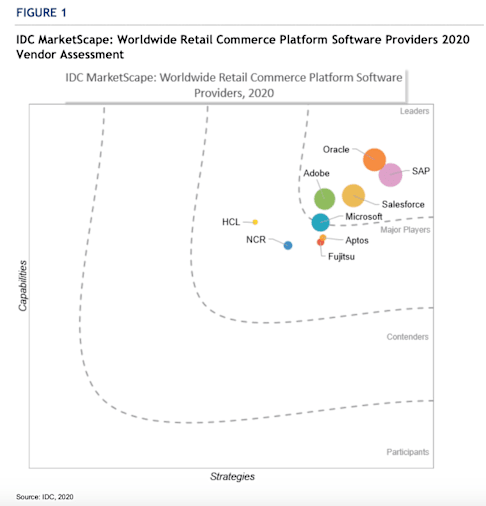
FIGURE 1
IDC MarketScape: Worldwide Retail Commerce Platform Software Providers 2020
Vendor Assessment
Source: IDC, 2020
©2020 IDC #US46038320e 2
Please see the Appendix for detailed methodology, market definition, and scoring criteria.
IN THIS EXCERPT
The content for this excerpt was taken directly from IDC MarketScape: Worldwide Retail Commerce
Platform Software Providers 2020 Vendor Assessment (Doc #US46038320). All or parts of the
following sections are included in this excerpt: IDC Opinion, IDC MarketScape Vendor Inclusion
Criteria, Essential Guidance, Vendor Summary Profile, Appendix and Learn More. Also included is
Figure 1.
IDC OPINION
As the socioeconomic situation is changing at a dramatic speed, so are new trends in the retail
industry. Beyond balancing the need to innovate toward Commerce Everywhere business models and
the efficient management of daily retail operations, retailers are facing new and disruptive challenges.
The relationship between innovation and profitability pushes retailers to abandon legacy structures
and accelerate their path toward business resiliency.
How can retailers prepare themselves for the future of retail while driving innovation at speed and
scale? Not all retailers are equally responsive to change. Retailers such as Walmart, Kroger, and
Walgreens are leading the way for Commerce Everywhere business models, investing on the
essential capabilities of a retail commerce platform and on innovative technologies. According to IDC's
2020 Global Retail Innovation Survey, building a platform for innovation remains the top challenge for
innovation strategy–laggard retailers. Around 64% of retailers globally plan to implement retail
commerce platforms over the next 12 to 24 months. This trend might differ across:
▪ Retail subsegments. For instance, 56% of ecommerce retailers have already implemented
and are currently in the process of implementing a retail commerce platform, followed by
fashion and specialty retailers (in which 69% and 65% of retailers are implementing and plan
to implement a retail commerce platform in 12 months, respectively).
▪ Geographical regions. In the Asia/Pacific region, 24% of retailers have already implemented a
retail commerce platform, while 41% of European retailers and 36% of U.S.-based retailers
are planning to implement a retail commerce platform by 2021.
▪ Retail commerce platform–specific capabilities. Retailers assign a different priority to each
platform-enabling component. Customer experience (CX) services, end-to-end security
services, and commerce services remain the top 3 innovation priorities as cited by 56%, 43%,
and 39% of retailers, respectively.
Based on our assessment of retail commerce platform vendors' offerings for this IDC MarketScape, we
can highlight the following key aspects:
▪ Retail innovation. The retail commerce platform is an essential enabler of innovation, as it
enables retailers to pilot, implement, and scale innovation at speed. However, they must
consider that retail innovation goes well beyond the implementation of new technologies.
Retailers should aim for fundamentally point at business model innovation through the
development of an innovation culture, the definition of an innovation strategy, execution based
on a retail commerce platform, and the attainment of long-term profitable growth — building up
what we call retail innovation excellence. Most vendors could aim to considerably improve in
providing retail-focused innovation services around retail business model innovation rather
than implement new technologies.
▪ Commerce everywhere. Commerce Everywhere business models involve relational and
operational retail processes that rely on the streamed collection and enablement of internal
and ecosystem data. Such models identify real-time, contextual, and interface-agnostic
©2020 IDC #US46038320e 3
customer experience as the pivotal gear of a company's value proposition, which links CX
back to the extended value chain of the enterprise, suppliers, and partners. These new models
are designed to operate "commerce" beyond the "transaction" and "everywhere" beyond
"customer-facing;" the ecosystem collaboration mindset needed to execute them requires
them to be innovation driven. New CX-oriented value is generated within each branch of the
extended value chain, from upstream to downstream. This means ecommerce will be
abstracted as a consumer interface, and its specific capabilities will be merged within the
overall capabilities of the retail commerce platform's core commerce services.
▪ Microservices approach. For many years, retailers have invested in monolithic platforms that
were based on traditional IT architecture, in which modules were customized and integrated
with many other legacy systems. Over the past couple of years, large retailers have started to
move toward microservices-based retail commerce platforms to become more agile and
achieve the flexibility to rapidly deploy new services and capabilities, following a best-of-breed
approach. Most vendors in this study provide services around cloud integration and
application programming interface (API)- and microservices-based architecture transformation
to support retailers in implementing, rapidly expanding, and innovating their retail commerce
platform capabilities. Some vendors are also improving the platform extension marketplaces
that enable retailers to go to market faster with new capabilities that can be sourced directly
from vendors or their partner ecosystems.
▪ Artificial intelligence/machine learning (AI/ML) analytics foundations. The implementation of a
retail commerce platform will rely on a solid core combined with a best-of-breed approach; it
will primarily leverage AI/ML analytics foundations. An intelligence core is essential for
continuously gathering and processing real-time and streamed data from consumers,
products, inventories, and partners, as well as customer activity. Several vendors are
developing proprietary AI platforms and attracting most AI talent, continually collecting data
from several segments and geographies for quickly improving AI algorithm performance.
These vendors are investing resources to cover specific retail domains, potentially integrating
and complementing capabilities that support retail commerce platform services with offerings
from specialized partners.
IDC MARKETSCAPE VENDOR INCLUSION CRITERIA
In this IDC MarketScape, IDC Retail Insights assesses the capabilities and strategies of leading
enterprise software vendors in serving the specific needs of retail companies worldwide across
industry segments (food and nonfood retail). Vendors will be evaluated according to their success in
designing, developing, installing, configuring, and maintaining the evolution of a complete retail
commerce platform (as shown in Figure 2). The target platform taken as a reference includes all core
capabilities that enable CX differentiation and seamless commerce, along with the required
operational efficiencies for profitability and business model agility. The core capabilities of the platform
are:
▪ Customer experience services. This enables the discovery of the customer context, real-time
customer journey personalization (including loyalty), and customer interface enablement
across voice, image, text, and augmented reality (AR).
▪ Commerce services. These capabilities provide a single, unified engine to process
transactions, from order capture though configuration and payments to delivery setup.
▪ Order fulfillment services. These capabilities provide fulfillment optimization through
networked-based fulfillment, fulfillment objectives and KPIs (for example, optimized margins or
delivery speed depending on the customer), efficient delivery execution, and returns
management.
▪ Content optimization services. These provide content management and adaptive,
personalized content distribution.
©2020 IDC #US46038320e 4
The retail commerce platform relies on a cloud-first architecture (with possibility of on-premises, public
cloud, private cloud, or hybrid cloud delivery, when necessary). It provides development services and
API-based integration with enterprise services, data services, and consumer services, while delivering
business logic and retail commerce services for four core capabilities. It also leverages AI, ML, or an
advanced analytics foundation. The retail commerce platform also provides proprietary or third party–
sourced development services that enable retailers to address application modernization,
development paradigm, code packaging shift, and cloud deployment.
To be included in this report, IDC Retail Insights analysts stipulated that vendors should meet the
following minimum criteria:
▪ The vendor should have a worldwide geographic coverage. The provider demonstrates
evidence of strong market penetration through direct presence and knowledge of the U.S.,
EMEA, and Asia/Pacific business context. The provider must be able to support global
retailers in their activities and expansion across mature and emerging markets.
▪ The vendor must support clients in designing, developing, installing, configuring, and
maintaining systems, applications, or platforms that run the business. It needs to deliver
software solutions (and hardware, when available) regarding the core capabilities of the retail
commerce platform (CX services, commerce services, order fulfillment services, and content
optimization services, including the real-time integration layer). Furthermore, the provider must
be able to deliver the platform as a cloud-first solution (and possibly deliver on premises or as
public, private, or hybrid cloud, when necessary). The vendor also must have the capability to
provide AI foundations embedded in the four core capabilities.
▪ The provider must have relevant experience in implementing retail industry software solutions
in the broadest possible set of industry processes and segments; providers with no relevant
experience will not be included.
In this edition of the IDC MarketScape, IBM and Infor were considered for inclusion but did not meet
one or more of the inclusion criteria.
▪ IBM has disinvested some of the IBM Commerce portfolio. In 2018, IBM signed an agreement
with HCL Technologies to divest selected IBM software products, including WebSphere
Commerce and Digital Commerce. Therefore, IBM's offering no longer covers retail commerce
platform capabilities that this IDC MarketScape aims to assess.
▪ Infor has renewed its retail focus and changed its product portfolio. The vendor is investing in
the retail and fashion industry, offering products focused on network collaboration, end-to-end
visibility, operational control of forecast, supply chain, inventory management, workforce
management, and product innovation. Therefore, the vendor no longer offers retail commerce
platform capabilities as part of an Infor product offering, such as its native Converged
Commerce platform, which was evaluated on the last edition of this research.
ADVICE FOR TECHNOLOGY BUYERS
The retail commerce platform is an essential enabler of innovation. It delivers empathy at scale as it
enables retailers to pilot, implement, and scale innovation at speed. As retail organizations evaluate
and plan investments for introducing or enhancing their commerce platforms, IDC recommends that
they consider the following:
▪ Accelerate retail commerce platform investments to successfully implement innovation,
differentiate CX, enable Commerce Everywhere business models, and facilitate a unified and
data-centric digital retail commerce platform approach.
▪ Implement an AI/ML foundation road map that embeds advanced analytics, machine learning,
and AI capabilities right into the application components of the platform, as and when
necessary. Retailers should select vendors that have developed a proprietary AI platform,
taking advantage of their broad ecosystems to support retail commerce platform services.
©2020 IDC #US46038320e 5
▪ Move beyond omni-channel. Customer interfaces, moments of interaction, and engagement
input (text, image, voice, video, AR) within the platform enable more rapid delivery of
consumer services and more efficient and personalized execution of customer journeys. CX
differentiation is built on a new way to collect customer data and deliver real-time contextual
experience services to consumers. In this context, marketing and advertising represent the
last mile to increase customer knowledge and engagement across the entire customer
journey. Retailers should prioritize vendors that provide capabilities and services for managing
marketing and advertising strategies as part of CX strategies.
▪ Select vendors that supplement the retail commerce platform core offering with innovation
services. These services should center around business model innovation and support
retailers in building a companywide innovation culture and strategy, with technology as an
enabler of retail innovation and long-term profitable growth.
▪ Design integration services among the four core components of retail commerce platforms
and to/from enterprise services, consumer services, and data services. An API- and
microservices-based architecture should support the implementation and rapid expansion of
retail commerce platforms' capabilities by following a best-of-breed approach. Select retailers
that offer a platform extension marketplace with an appropriate retail catalogs and
demonstrated ease of integration of third-party services.
▪ Define a clear digital road map. In the context of the next normal, targeted investments in retail
business use cases need to be reprioritized. Retailers should engage with vendors that
provide a strong and long-term, retail use-case road map offering, demonstrate the ability to
scale, and indicate plans to support retailers in innovating their business models in response
to unexpected changes.
▪ Seek vendors' partner ecosystems. The implementation of retail commerce platforms with a
best-of-breed approach requires a strong innovation culture. Select vendors that have a
propensity to an open ecosystem approach and are open to new ideas, investing in retail
R&D, M&A, and retail technology start-ups.
VENDOR SUMMARY PROFILES
This section briefly explains IDC's key observations resulting in a vendor's position in the IDC
MarketScape. While every vendor is evaluated against each criterion outlined in the Appendix, the
description here provides a summary of each vendor's strengths and opportunities.
Oracle
Oracle is positioned in the Leaders category in this 2020 IDC MarketScape for Worldwide Software
Providers of Retail Commerce Platforms.
Oracle is a software, hardware, and services provider with headquarters in Redwood, California.
Founded in 1977, the company has more than 136,000 employees globally. Oracle has more than
430,000 customers with a presence in 175 countries.
Oracle's retail commerce platform capabilities come from the combination of its Oracle CX Commerce
portfolio (part of the Oracle Cloud CX Platform), which has an API-first architecture, and Oracle Retail
Cloud.
Customer experience services provided by Oracle aim to manage the entire customer journey through
application areas (especially data services, marketing, sales, content and experience, customer data
management, and analytics). These applications leverage Oracle Cloud Infrastructure platform
capabilities. Oracle recently introduced a cloudlet (as part of Oracle's Xstore Point-of-Service) that
monitors the response times of applications running on mobile devices; Fully Mobile Store, which
enables in-store customer and employee experiences; and Next Expected Purchase, leveraging
predictive analytics for customer engagement (e.g., personalized offers).
©2020 IDC #US46038320e 6
In the past three years, the vendor has delivered its Gen2 Cloud Infrastructure and Innovation
Platform, which enables Oracle CX Commerce to support multiple types of product sales (one-time
purchases, subscriptions, hybrid models, etc.) and provide customer support.
Oracle supports order fulfillment services through the Oracle Retail Order Management System Suite.
This suite provides distributed order-broker and drop-ship options, real-time inventory, and intelligent
routing by leveraging the Oracle Retail Advanced Science Engine (ORASE) for data management. It
can be integrated with retailer's own OMS and call center functions.
Oracle CX includes Oracle's core content management services. It relies on the concept of a
centralized hub for content management functions such as content creation, collaboration, metadata
management, content workflows, and publishing activities. The API architecture enables retailers to
access Oracle CX content services through custom and mobile applications and vocal devices.
Oracle leverages AI/ML capabilities through its retail commerce platform services, including other
Oracle suite applications, such as Oracle Marketing Cloud and Oracle Data Cloud (ODC). ODC,
Oracle's third-party data marketplace, is also a major component of the Oracle Retail Insights (RI)
Suite and Commerce solutions. Moreover, Oracle Retail Insights Suite leverages AI and ML analytics
for data pooling, inventory visibility, CX personalization, customer loyalty data, product
recommendations, targeting, and promotions.
Strengths
▪ Among the retail commerce platform vendors assessed in this IDC MarketScape, only Oracle
reported considerable investment in retail technology innovation and retail-specific R&D over
the past three years, with appropriate focus on areas that are strategic for retailers.
▪ According to a customer, Oracle supports retail teams throughout projects and demonstrates
particular attention in managing the relationship effectively.
▪ As part of Oracle's retail-specific technical support, the vendor also enables its clients to
access to the Retail Reference Library, which collects delivery and development process flows
and best practices that retailers can replicate to solve immediate issues.
Challenges
▪ According to customers, the implementation lead time for Oracle's retail commerce platform
took longer than expected, due to some issues that the retailer and the vendor encountered in
the initial stages of the process.
▪ According to customers, Oracle has space for improvement in technical integration and ease
of upgrades to new versions.
▪ Customers are of the opinion that the user interface could be enriched to improve employee
experience. To address this, Oracle has recently introduced a new UI/UX technology
framework called Redwood. Oracle is planning to make the new framework available in its
portfolio of applications in the future.
APPENDIX
Reading an IDC MarketScape Graph
For the purposes of this analysis, IDC divided potential key measures for success into two primary
categories: capabilities and strategies.
Positioning on the y-axis reflects the vendor's current capabilities and menu of services and how well
aligned the vendor is to customer needs. The capabilities category focuses on the capabilities of the
company and product today, here, and now. Under this category, IDC analysts will look at how well a
vendor is building/delivering capabilities that enable it to execute its chosen strategy in the market.
©2020 IDC #US46038320e 7
Positioning on the x-axis or strategies axis indicates how well the vendor's future strategy aligns with
what customers will require in three to five years. The strategies category focuses on high-level
decisions and underlying assumptions about offerings, customer segments, and business and go-to-
market plans for the next three to five years.
Vendor footprint, depicted by the size of the bubble, is based on IDC Retail Insights' best estimates of
the vendor revenue on a global basis for software (together with hardware and IT services, when
available) related to the Retail Commerce Platform.
IDC MarketScape Methodology
IDC MarketScape criteria selection, weightings, and vendor scores represent well-researched IDC
judgment about the market and specific vendors. IDC analysts tailor the range of standard
characteristics by which vendors are measured through structured discussions, surveys, and
interviews with market leaders, participants, and end users. Market weightings are based on user
interviews, buyer surveys and the input of IDC experts in each market. IDC analysts base individual
vendor scores, and ultimately vendor positions on the IDC MarketScape, on detailed surveys and
interviews with the vendors, publicly available information and end-user experiences in an effort to
provide an accurate and consistent assessment of each vendor's characteristics, behavior and
capability.
Market Definition
In this IDC MarketScape, IDC Retail Insights assesses the capabilities and strategies of leading
enterprise software vendors in serving the specific needs of retail companies worldwide across
industry segments (food and nonfood retail). Vendors will be evaluated according to their success in
designing, developing, installing, configuring, and maintaining the evolution of a complete retail
commerce platform (Figure 2) that includes all the core capabilities that enable customer experience
differentiation and seamless commerce — CX services, commerce service, order fulfillment services,
and content optimization services.
Customer experience is a key priority, and most retailers globally feel the pressure to adopt
experience-based business models, prioritizing investments in specific areas such as hyper-
personalization and real-time contextual interactions. CX-focused organizations are reinventing how
commerce works, combining commerce with interactive activities to create more meaningful
connections with customers and, ultimately, to boost sales.
©2020 IDC #US46038320e 8
FIGURE 2
IDC Retail Commerce Platform Architecture
Source: IDC, 2020
As stated in IDC's Worldwide Digital Transformation Use Case Taxonomy, 2020: Experiential Retail
(IDC #US44303120, July 2020), IDC has identified a digital mission of the retail industry, strategic
priorities that support that mission, programs that will be initiated to satisfy these priorities, and the
funded use cases that will be implemented under those programs. These are summarized in Table 1.
While this taxonomy is an extensive representation, it is not exhaustive.
Vendors can fulfill one strategic priority gap — and eventually enrich some capability that is part of their
services — through proven collaborations with external partners.
TABLE 1
IDC's Worldwide Digital Transformation Use Case Taxonomy, 2020: Experiential
Retail
Strategic Priorities Programs Use Cases
Omni-channel commerce Experiential commerce Commerce service
Digital content management
Cashierless checkout
Headless commerce
Next-gen payments
Intelligent fulfillment and returns Omni-channel order orchestration and
fulfillment
Just-in-time (JIT) production
Real-time inventory management
Virtual and augmented experience Virtual and augmented engagements
Digitally connected product experiences
©2020 IDC #US46038320e 9
TABLE 1
IDC's Worldwide Digital Transformation Use Case Taxonomy, 2020: Experiential
Retail
Strategic Priorities Programs Use Cases
Augmented and visual product
discovery
Curated merchandise life-cycle
management
Intelligent product design 3D product design and review
Crowdsourced ideation and innovation
Sustainable product life-cycle design
Curated product assortment and
positioning
Assortment optimization
Sentiment analysis
Dynamic pricing
Life-cycle pricing optimization
Product innovation B2B networks/marketplaces
Digital product life-cycle management
Global product requirement compliance
Omni-experience customer
engagement
Next-generation customer care Optimized customer relationship/loyalty
programs
Omni-channel customer support
Social marketing
CX analytics 360-degree connected customer data
management
CX and behavior analytics
Digital content optimization
CX process management
Hyper-personalized engagement Contextualized marketing
Optimized promotion development and
distribution
Omni-channel marketing and advertising
Digital supply chain optimization Optimized supply networks Dynamic supply network management
Supply forecasting and planning
Optimized fulfillment operations Predictive network inventory
orchestration
Advanced technology augmented work
Optimized operations
Advanced enterprise reverse logistics
execution
Supply chain accountability Traceability
©2020 IDC #US46038320e 10
TABLE 1
IDC's Worldwide Digital Transformation Use Case Taxonomy, 2020: Experiential
Retail
Strategic Priorities Programs Use Cases
Smart financial supply chain
Supply chain safety and compliance
management
Efficient and innovation-ready
operations
Mobile enterprise Mobile inventory information
management
Mobile task management
Mobile customer engagement
Connected workforce Digital workforce management
Empowered worker
Augmented knowledge worker
Robotic worksource
Digital sales training and execution
Secure omni-channel operations Fraud management
Next-gen digital security
Next-gen loss prevention
Profitability optimization Sustainable environment optimization
Asset management
Physical safety and risk management
Venue portfolio management
Revenue and margin assurance
Source: IDC, 2020
LEARN MORE
Related Research
▪ IDC FutureScape: Worldwide Retail 2021 Predictions (IDC #US46921120, October 2020)
▪ The Status of Retail Customer Experience in the Next Normal: Challenges and Opportunities
for Improving Customer Experience at Scale (IDC #EUR146598721, October 2020)
▪ Commerce Everywhere Business Models and the Path Toward Retail Innovation Excellence
(IDC #EUR146908220, October 2020)
▪ IDC MaturityScape: Retail Customer Experience Personalization (IDC #EUR146782620,
September 2020)
▪ IDC's Worldwide Digital Transformation Use Case Taxonomy, 2020: Experiential Retail (IDC
#US44303120, June 2020)
©2020 IDC #US46038320e 11
▪ IDC PeerScape: Practices to Enable Food and Grocery Retailers of the Future (IDC
#US43664619, June 2020)
Synopsis
This IDC MarketScape assesses the capabilities and strategies of several key enterprise software
providers in serving the specific needs of retail companies worldwide across industry segments (food
and nonfood retail). Vendors are evaluated according to their successes in designing, developing,
installing, configuring, and maintaining the evolution of a retail commerce platform's services. The
target platform taken as a reference includes the core capabilities that enable CX differentiation and
seamless commerce, along with the required operational efficiencies for profitability and business
model agility.
"As the socioeconomic situation is changing at a dramatic speed, so are new trends in the retail
industry. Beyond balancing the need to innovate toward Commerce Everywhere business models and
the efficient management of daily retail operations, retailers have to abandon legacy structures and
accelerate investments in implementing a retail commerce platform's essential capabilities and
innovative technologies" said Ornella Urso, senior research analyst, IDC Retail Insights. "Retail
software vendors are rapidly evolving their API- and microservices-based retail commerce platform
strategies and capabilities, enabling retailers to become more agile and achieve the flexibility to rapidly
deploy new services and capabilities, following a best-of-breed approach."
About IDC
International Data Corporation (IDC) is the premier global provider of market intelligence, advisory
services, and events for the information technology, telecommunications and consumer technology
markets. IDC helps IT professionals, business executives, and the investment community make fact-
based decisions on technology purchases and business strategy. More than 1,100 IDC analysts
provide global, regional, and local expertise on technology and industry opportunities and trends in
over 110 countries worldwide. For 50 years, IDC has provided strategic insights to help our clients
achieve their key business objectives. IDC is a subsidiary of IDG, the world's leading technology
media, research, and events company.
IDC Italy
Viale Monza, 14
20127 Milan, Italy
+39.02.28457.1
Twitter: @IDCitaly
idc-insights-community.com
www.idcitalia.com
Copyright and Trademark Notice
This IDC research document was published as part of an IDC continuous intelligence service, providing written
research, analyst interactions, telebriefings, and conferences. Visit www.idc.com to learn more about IDC
subscription and consulting services. To view a list of IDC offices worldwide, visit www.idc.com/offices. Please
contact the IDC Hotline at 800.343.4952, ext. 7988 (or +1.508.988.7988) or sales@idc.com for information on
applying the price of this document toward the purchase of an IDC service or for information on additional copies
or web rights. IDC and IDC MarketScape are trademarks of International Data Group, Inc.
Copyright 2020 IDC. Reproduction is forbidden unless authorized. All rights reserved.